
Writings
The writings collated here on aspects of the histories of psychoanalysis include selected works by both the editors and a growing body of other contemporary researchers, academics, scholars, and clinicians. Use the index on the left to navigate through the authors and their works. As part of the development of this collection, we are also publishing a series of early responses to psychoanalysis, under the banner 'Reclaiming Lost Texts', and an occasional array of longer reflections, under the term 'Sidelights'. Comments on and contributions to these various series are welcome.
Select an Author:
Author: Philip Graham
Published: 2008

This paper gives an account of the five-year (1924–1929) history of The Malting House School in Cambridge. The school was financed by Geoffrey Pyke and headed by Susan Isaacs, a teacher, psychologist and early member of the British Psychoanalytical Society, who became a leading advocate of the ideas of Melanie Klein. The physical structure, organisation, philosophy and curriculum of the school are described. Although lasting only five years, through the work of Susan Isaacs the school had an enduring impact on early years education.
Ernest Jones’s 1906 trial for indecent assault - 4 (The 1906 defence fund)
Ernest Jones’s 1906 trial for indecent assault - 4 (The 1906 defence fund)
Author: philip kuhn
Published: 2024

A few days after Jones was acquitted of charges of indecent assault, both the British Medical Journal and the Lancet lifted their respective self-imposed sub-judice silences in order to run short articles commenting upon the affair. The Lancet congratulated 'Dr Alfred Ernest Jones upon his complete exoneration from the infamous and perfectly incredible charges brought against him in connexion with his official visits at the schools for defective children'. The article reveals those who contributed to this fund, thus shining a light on the limited extent of support for Jones in the medical establishment.
Reclaiming Lost Texts, No. 1: William & Clara Stern's criticisms of child psychoanalysis
Reclaiming Lost Texts, No. 1: William & Clara Stern's criticisms of child psychoanalysis
Author: philip kuhn
Published: 2026

This text introduces and contextualises William and Clara Stern’s early 20th-century criticisms of psychoanalysis, particularly its application to children. It presents their 1914 essay 'A Protest' and appendix critiquing Freud’s child analysis, arguing that psychoanalysis overemphasises sexuality, misinterprets childhood behaviours, and risks psychological harm through suggestion and premature sexualisation. The Sterns advocate for empirical, humane child psychology and warn against psychoanalytic methods in education. The document also explores the historical context, the Sterns’ influence on developmental psychology, their interactions with Freud, and the subsequent erasure of their critiques from mainstream psychoanalytic history.
Controversies in the English publication of Freud's The Interpretation of Dreams, 1913-1933
Controversies in the English publication of Freud's The Interpretation of Dreams, 1913-1933
Author: Roger Willoughby
Published: 2024

The transition of Freud’s Die Traumdeutung into The Interpretation of Dreams, translated by A.A. Brill, took several years to effect, the process being beset with conceptual, practical, legal, and political obstacles. Anxieties over possible obscenity charges in Britain led to novel forms of censorship being applied to the first edition by its London publisher in 1913, while issues relating to the politics of translation and local British efforts to standardise psychoanalytic nomenclature would bedevil the text over its first two decades. The present article critically discusses all this and more. The shadow of this history falls on the Revised Standard Edition.
The tradition of lying: The defamation of the writer Wilhelm Jensen by Sigmund Freud and his 'school'
The tradition of lying: The defamation of the writer Wilhelm Jensen by Sigmund Freud and his 'school'
Author: Klaus Schlagman
Published: 2025

After my essay on the realitiy of life of Wilhelm Jensen - completely misunderstood by Freud - I stumbled in 2022 on a reference to an archival discovery: a letter from Jensen to Wilhelm Stekel from 1903 had surfaced. It now allows us to judge that Freud, even in the very act of writing his essay, began a defamation of Jensen, a defamation that has virtually never been tested or revised in light of reality for over a hundred years. These explanations are supplemented by references to other episodes that show how Freud's interpretations often stand in stark contrast to observable reality.
Adolf Joseph Storfer: Journalist, Editor, Director of the Internationalen Psychoanalytischen Verlags 1925-1932
Adolf Joseph Storfer: Journalist, Editor, Director of the Internationalen Psychoanalytischen Verlags 1925-1932
Author: Inge Scholz-Strasser
Published: 1995/2026
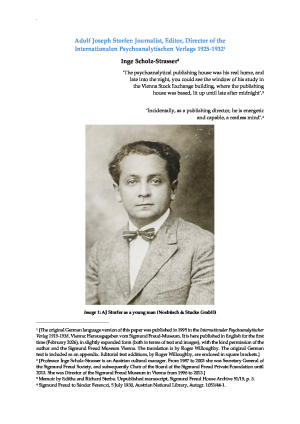
Adolf Joseph Storfer (1888–1944) was a pivotal figure in psychoanalytic publishing, directing the International Psychoanalytical Publishing House (commonly referred to as the Verlag or IPV) from 1925 to 1932. Storfer, a linguist, journalist, and member of the Vienna Psychoanalytic Society, expanded the IPV’s output despite persistent financial crises and internal conflicts, notably with Freud’s circle. He edited major works, including Freud’s Gesammelte Schriften [Collected Writings], and founded influential journals. Storfer’s later years were marked by exile and declining health, yet his editorial leadership significantly shaped the dissemination of psychoanalytic thought.