
Blog
Select a Contributor
Select a Year
From Household Intimacy to Historical Neglect: The Afterlife of Minna Bernays
 Image 1: Freud Corner in the Ernest George Columbarium in Golders Green Crematorium
Following on from the example set by his eldest brother, Emanuel, Sigmund Freud opted – against Jewish tradition – to be cremated when he died in 1939, as did Martha and their children. Today, their ashes are preserved in the Ernest George Columbarium in Golders Green Crematorium, clustered together in ‘Freud Corner’, the ashes of Freud and Martha in an antique 4th-century BC Southern Italian-Apulian bell-shaped krater in the Greek tradition, while those of their children and several friends are stored in an assortment of wooden and metal urns.
 Image 2: Freud family urns, Anna Freud (top) and Ernst Freud (bottom), with the urns of Oliver Freud and Dorothy Burlingham in the background
In stark contrast to the carefully curated and maintained urns in Freud Corner, the final resting place of Minna Bernays (1865-1941),[1] Freud’s sister-in-law, lies in a state of quiet neglect a few hundred yards away, across the road in Hoop Lane Jewish Cemetery. Following her death on 12 February 1941 as a result of coronary disease, Minna – who had maintained her filiation with Judaism (unlike Freud, though like his older brother Philipp) – was buried there four days later. Today, the text on the matzevah marking her grave is so weathered as to be illegible. A small Star of David carved into the stone is just about discernible.
 Image 3: Minna Bernays' matzevah in Hoop Lane Cemetery, London, NW11 7NJ
Minna had lived as part of the Freud household in Berggasse 19 substantively from November 1895, assisting her sister with the children and the housekeeping. Freud liked Minna from when he first met her. And she liked him: Berthelsen described Minna’s attitude to Freud as one of ‘aggressive admiration’.[2] They would talk about ideas. They would travel on holiday together. They had a reasonably extensive correspondence with each other.[3] Minna was a regular in Freud’s Saturday evening Tarok and later Mahjong circles. She would borrow popular fiction for Freud from local libraries and frequented the Fremdsprachige Leihbibliothek (which was run by Ilse Moebius and Gertrude Kvergic-Kraus) between 1929-1938, where she sourced English language detective and crime novels.[4] Freud liked reading these during his down time. And there was and remains considerable speculation that they had a sexual relationship, though the evidence for that is very thin indeed.[5]
While Freud and Minna had a good relationship (as Martha and Minna appear to have had too), it was not so for others in the Freud household. The maid, Paula Fichtl (1902-1989), felt put down and unfairly picked on by her.[6] More relevantly, Freud’s niece Hella Bernays (1893-1994) claimed that:
Minna was a cat, a-- I didn't know her very well. But she was a venomous, trite, well, in English you would say ‘cat’. … when they were children, the Freud children hated Tante Minna. And as they matured, as Mathilde matured she saw her worth as a human being. But I think it’s quite understandable that the children would [hate her] [emphasis added].[7]
In such an emotional environment, with Minna economically vulnerable[8] and dependent, it is unsurprising that Freud had left her an annuity of £300 in his will. She needed it. Following both their deaths, their posthumous fates have been split. Minna’s burial was probably in accordance with her wishes and her sustained Judaism. Yet, while Freud’s intellectual legacy has – with ups and downs – proliferated, his homes and collections are curated in the Freud Museums in London and Vienna, and his physical remains are well looked after in Golders Green Crematorium,[9] Minna’s dignity has been less well preserved by subsequent generations. Reduced to a sometimes-difficult member of the supporting cast in the Freud drama, or under the misogynistic shadow of being the ‘other woman’, the neglect of Minna’s matzevah in Hoop Lane Cemetery is sad and telling. For those who wish to make the pilgrimage, Minna’s grave is in the West London Synagogue portion of Hoop Lane Cemetery and can be found in section C, row 41, plot 16.
Acknowledgement: My thanks to my friend Chris Tögel for inspiring this post with comments he made while walking in Vienna on 13 March 2025.
Roger Willoughby, 20 September 2026
 Image 4: The Star of David, faintly discernable, on Minna Bernays's matzevah
Notes:
[1] For an accessible account of Minna Bernays see Albrecht Hirschmüller ‘Bernays-Freud, Minna (1865-1941’, in Alain de Mijolla (ed) International Dictionary of Psychoanalysis, volume 1, Farmington Hills, Thomson Gale, 2005, pp. 167-168.
[2] Detlef Berthelsen Alltag bei Familie Freud: Die Erinnerungen der Paula Fichtl, Munich: Deutscher Taschenbuch Verlag, 1989, p. 40.
[3] Albrecht Hirschmüller (ed) Sigmund Freud Minna Bernays Briefwechsel 1882-1938, Tübingen: Edition Diskord, 2005.
[4] Christfried Tögel & Jörg-Dieter Kogel Sigmund Freud in the Eyes of Others: Biographical Vignettes with a Bit of Gossip, London: Karnac, forthcoming.
[5] Albrecht Hirschmüller (2007) ‘Freud and Minna Bernays: Evidence for a sexual relationship between Sigmund Freud and Minna Bernays?’, American Imago, 64, 1, pp. 125-129.
[6] See for example Fichtl’s comments during her interviews with Kurt Eissler on 20 December 1955, p. 3, and 6 January 1956, p. 12 (Library of Congress, Washington, DC). See also Detlef Berthelsen Alltag bei Familie Freud: Die Erinnerungen der Paula Fichtl, Munich: Deutscher Taschenbuch Verlag, 1989, pp. 23 and 35.
[7] Hella Bernays in interview with Kurt Eissler, 17 September 1955, Library of Congress mss39990, box 113, pp. 28-30.
[8] Minna’s estate would amount to just £193 when it was valued for probate purposes following her death.
[9] One caveat to this claim should be noted: On the night of 31 December 2013-1 January 2014, intruders broke into the Ernest George Columbarium and in an apparent attempt to steal the bell krater containing the Freuds’ ashes the bell krater fell to the ground, was severely damaged, and left there. Apparently, the sealed inner container remained intact. The krater was subsequently restored and today it stands once again on the black marble pedestal designed by Ernst L. Freud, but behind special glass and under heightened security.
I thought I had seen it all!
I thought I had seen it all!
In 2021 I was invited by the book review editor of the Journal of the History of the Behavioral Sciences to write a review of ‘Richard Evans, Conversations with Carl Jung and Reactions from Ernest Jones’ which had just been published in a new edition edited by Jodi Kearns, issued as part of The Centre for the History of Psychology Series, and published by The University of Akron Press (2020).
I found the book to be highly questionable and the new edition to be based upon shoddy scholarship and I said so in no uncertain terms. My review was then published in the Journal of the History of the Behavioral Sciences (2021, Vol. 57 (4), p.441-443) which is an imprint of Wiley. So you can perhaps imagine something of my shock when I stumbled upon these comments on the Wiley web site:
Philip Kuhn’s review in the Journal of the History of the Behavioral Sciences highlights Conversations with Carl Jung and Reactions from Ernest Jones for providing an unfiltered, candid look at Jung’s later life and personality. The review notes the work’s success in contrasting Jung’s perspectives with orthodox Freudian views, offering valuable insight through spontaneous interviews.
This is complete and utter rubbish and it is not remotely what I said. Once I had got over my initial shock, I set about looking at some of the other summaries of my review and this is what I found:
Summary of Kuhn’s Critique
The Interplay of Dialogue: Kuhn evaluates the transcripts stemming from Evans’ 1957 interviews in Zurich. He notes how the interview format reveals Jung’s intellectual vigor in his later years, allowing him to explain his pioneering concepts – like archetypes, individuation, and psychological types – in a conversational tone.
Historical Context: The review delves into the historical ‘reactions from Ernest Jones’ included in the book, contrasting the views of both early psychological pioneers. It frames the text not as an introductory textbook, but as a critical primary source for historical enthusiasts and scholars.
The Nature of Ideas: Kuhn focuses on the broader diffusion of Jungian ideas, challenging or analyzing how the subjective nature of an interview reflects the dynamic personality of Jung himself, outside of his ‘prophetic image’.
I then went to look at the Archon website and although they are still advertising and selling the book they remain noticeably silent about my review.
As a counter to the slop generated by AI I now post my original review here but in the meantime I will conclude this post with the final summary of my review courtesy of Microsoft’s Co-pilot.
Kuhn argues the result is a historically naïve, uncritical, and outdated volume that ignores modern scholarship, racial and antisemitic controversies, and the historiographical problems in both Jung’s and Jones’s narratives.
philip kuhn 15 September 2026
Between effacement and Chemins Croisés

Life’s journeys are uncertain, although we receive glimmers along the way of fellow travellers and the ultimate destination and our inevitable effacement or erasure. Since reading the Three Essays when I was 15, perhaps even before, Freud became an important figure in my life, admired especially as a philosopher, as the author of the papers on metapsychology, of The Future of an Illusion, and so on. And a figure, a man, for whom I have empathy too. Our paths cross in various ways. In creating the five volumes of Chemins Croisés (or Crossed Paths) which are on this site, as well as in the library of the Belgian Psychoanalytic Society, the Sigmund Freud Museum in Vienna, the Freud Museum in London, and elsewhere, I have done so as something of a dialogue with Freud, his journeys to Italy and my photographic wanderings through that country which I had the good fortune to discover over sixty years ago. I have conceived them as a journey of quotations, free associations, memories, and photographs of the places I love.
It is not unnecessary to clarify the context in which this work came into being. In 2019, I received a cancer diagnosis and learned that I was not immortal. Now, death is a constant presence in my existence. I declined the degrading treatment that was offered to me in Paris and I set the limits of what I was willing to endure. I decided to revisit Rome, London, Athens, Florence, Venice.

I had intended to visit China again in the spring of 2020 and I had planned a journey from Shanghai to Guangzhou. Alas, as they say in Yiddish: dèr mentsh tracht un got lacht. Man makes plans and God laughs! As for China, the Covid pandemic swept across the world and to the constraints of my chemotherapy were added the liberty-restricting measures, the some reasonable, others arbitrary to the point of absurdity, masks, lockdowns, curfews, exemption certificates for travel, vaccinations. Last but not least, I had the grief of losing my Tervuren whom I loved and who loved me deeply and the grief was so intense and so long that it at times was intolerable.
These Chemins Croisés are not yet another biography of Freud. They have been for me a Trauerarbeit, a process of mourning. Freud is present, certainly, in the ruins of Pompeii, of Paestum, of Agrigento, and perhaps even more so of the Palatine Hill. Freud wandering through the antiquarian establishments on Via Margutta and on Via del Babuino and who reads on every shop sign the word ‘Antiques’. Freud who sets aside his Baedeker for the joys of a swim at Lido of Venice or at the beach of Sorrento. But he is also the archaeologist of the psyche, the author of the death drive, of the id, of The Future of an Illusion and of Civilization and Its Discontents. The Chemins Croisés are all accessible here and my 2 April 2026 Belgian Society of Psychoanalysis talk, which follows volume five, can be viewed here.
Luc Mary-Rabine, 15 May 2026

The Tagebuch Controversy: When Debate Meets a Wall
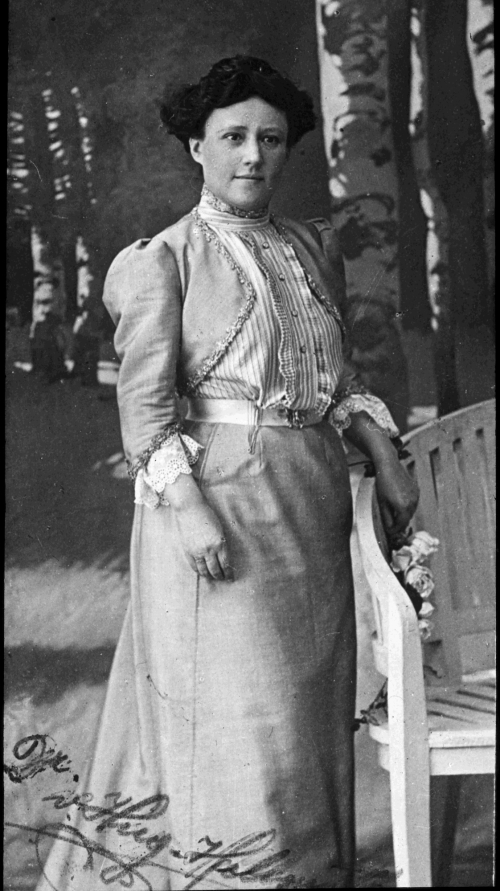 Image 1: Hermine Hug-Hellmuth, the only known photograph
(Image courtesy of the Oskar Diethelm Library, DeWitt Wallace Institute of Psychiatry, Weill Cornell Medical College, NYC)
My essay, ‘A curate’s egg of a book’, which is a highly critical review of The Forgotten Analyst: Hermine Hug-Hellmuth (1871-1924) by Prophecy Coles and published by Karnac, is now posted up on this site. After having finished writing that review, Roger and I agreed that it would be a courtesy to delay its publication so that we could send a copy to Karnac offering them and / or Prophecy Coles an opportunity to reply. In their response Karnac said:
Both Prophecy and the Karnac team are happy to let your review stand without an ‘official’ response. We understand that this is the nature of reviews, and our ethos here at Karnac is very much to stimulate debate, to present opposing theories, and above all to question everything.[1]
As it so happens these are virtually the same sentiments which Karnac also express on their site:
Our purpose is to stimulate debate, to open minds to new ways of working, to present opposing theories and above all to question everything.[2]
Following Karnac’s response I am left struggling to understand how I am supposed to reconcile these two apparently contradictory positions: in which Karnac aspires to stimulate debate but then, at the same time, declines – or should that be refuses? - to engage in debate. I believe that I have made some serious allegations against The Forgotten Analyst not least that the book claims to be about the life of Hermine Hug-Hellmuth but then fails to discuss what I can only refer to as the sordid history surrounding the fate of the Tagebuch eines halbwüchsigen Mädchens [Tagebuch] which was first published in 1919. After all it was the Tagebuch, which the initially anonymous editor [Hug-Hellmuth], claimed to be the authentic diary of an anonymous young girl and which was effusively endorsed by Freud, and which is generally considered to be one of the foundation-stones upon which Hug-Hellmuth’s reputation was built. This was certainly the view taken by Coles.
Questions concerning the authenticity of the Tagebuch can be traced back to Cyril Burt’s review which appeared in 1921 shortly after the Tagebuch had been translated into English as A Young Girl’s Diary. Although, at the time, Freud dismissed Burt’s criticisms, it was, in fact, Burt’s review which persuaded Freud to urge Hug-Helmuth to reveal herself as the Tagebuch’s editor. But matters were not that simple because, in the summer of 1926, Freud received an advance copy of Josef Krug’s ‘Kritische Bemerkungen - zu dem Tagebuch eines halbwüchsigen Mädchens’ (Critical Remarks - on the diary of an adolescent girl[3]) which was then published in the July 1926 issue of the journal co-edited by William Stern with Otto Lipmann. Krug’s essay clearly rattled Freud because he instructed A. J. Storfer, who was then managing director of the psychoanalytic publishing house and editor of the Almanach, to set about finding evidence that would undermine Krug’s arguments. Following what was, in effect, a nine month’s investigation, which included trawling through all the relevant newspapers of the time and also tracking down and interviewing people who might have known the anonymous diarist, Storfer was forced to conclude that he could find no evidence whatsoever to undermine Krug’s claim that the Tagebuch could not be the authentic diary of a young girl. Following Storfer’s exhaustive investigation, Freud was finally forced to conclude that Hug-Hellmuth’s Tagebuch was, at best, a deception and at worst a fraud and so he, and Anna Freud, opted to remove the Tagebuch from the psychoanalytic lists.
Although Krug’s allegations of ‘fraud’ were levelled against the Tagebuch in July 1926 and then finally accepted by Freud in February 1927, the episode has never been openly discussed by the psychoanalytic community. Now, with the return of the ‘repressed’, it again raises serious questions about the psychoanalytic canon, its history, and historiography. If Prophecy Coles, as the author, and Karnac, as the publisher, decline to respond to these allegations – which they are of course free to do so - then I would be interested to know how else Karnac might hope ‘to stimulate debate, to open minds to new ways of working, to present opposing theories and above all to question everything’. Without an answer to this fundamental question I can only assume that Karnac’s idea of debate is to leave both sides entrenched in their respective silos shouting across the divide rather than attempting to mediate discussion.
philip kuhn, 31 January 2026
[1] Izzy Da Silva, Publishing Assistant, Karnac Books to philip kuhn (email 5 January 2026)
[2] See https://firingthemind.com/about-us/
Breaking News in 1902 Vienna: Freud's Professorship
According to Michael Molnar, who used to be Research Director at the Freud Museum, London, there is a copy of Freud’s ‘Professorial Certificate’, dated 13 March 1902, which appears to confirm the official date of his appointment. It seems, however that Freud’s appointment was not made public until 18 March 1902 when it was officially announced on page one of the evening edition of the Neue Freie Press, thus:

This seems to have been the first paper to publish the news and a copy of the whole front page which carries the above announcement (in the second column under the line) can be found here.
Here is a rather rough translation of the relevant sentences:
Dr Sigmund Freud is a pupil of Meynert's and studied for a time with Charcot in Paris. He worked as a physician at the First Public Children’s Hospital in Vienna and has published works on the brain and neurological diseases of children and speech disorders and other anatomical themes. He has studied the effect of the healing value of cocaine which was first used in the Viennese general hospital and in 1884 published a work on Coca. In recent years Freud has been dealing with hysteria and related conditions. Also brain activity in sleep and waking states. He has published the Interpretation of Dreams that is characterized by a combination of the work on the brain undertaken by Meynert's school and the ingenious theories of the French concerning the organs of the soul.
(Neue Freie Press, (Abendblatt) Tuesday 18 March 1902, page 1)
A number of other papers also carried the announcement but with less detail. To date, I have been able to track down the following:
- Neues Wiener Tagblatt, (Tages-Ausgabe) 19 März 1902, p.7
- Österreichische Zeitschrift für Pharmacie, 22 März 1902, p.350
- Illustrirtes Wiener Extrablatt, 18 Marz 1902, p.2
- Ostdeutsche Rundschau, 18 März 1902, p.4
- em>Prager Tagblatt, 18 März 1902, p.5
- Das Vaterland, 18 März 1902, p.2
- Wiener Zeitung, 18 März 1902, p.1
- (Neuigkeits) Welt Blatt, 19 März 1902, p.2
- Neues Wiener Tagblatt, (Tages-Ausgabe), 19 März 1902, p.7
- Wiener Allgemeine Zeitung, 19 März 1902, p.2
- Wiener Klinische Wochenschrift, 20 März 1902, p.322
- Die Neuzeit, 21 März 1902, p.124
The only other announcement worth noting is the one from the Österreichische Zeitschrift für Pharmacie and here is a rough translation:
University News. The Emperor gladly appointed the private lecturer Dr Arthur Schattenfroh as associate professor of hygiene at the University of Vienna, and the private lecturers at the same university Dr Sigmund Freud, Dr Julius Mannaberg and Dr Emil Fronz were awarded the title of extraordinary university professor. Dr Arthur Schattenfroh, who is currently an assistant at the [Vienna] Hygienic Institute, has carried out numerous important studies on the causation of disease and bacterial poisoning; Dr Sigmund Freud, a student of Meynert and Charcot, works at the First Public Children's Hospital in Vienna and has published interesting studies on brain and nervous diseases, as well as on psychiatric topics; Dr Julius Mannaberg, head of department at the General Polyclinic, is known for his work on bacteria as a cause of disease and malaria; Dr Emil Fronz worked at the St Annen Children’s Hospital for a long time. Hofrath Prof Dr Krafft-Ebing, who is known to be nearing retirement, will head the psychiatric clinic until 1 May and then move to Graz.
(Österreichische Zeitschrift für Pharmacie, 22 März 1902, p.350)
The digital archive of Austrian newspapers and journals can be found at Anno Historische österreichische Zeitung und Zeitschriften.
philip kuhn, 30 January 2026
The Diary Withdrawn: New Light on Hug-Hellmuth's Life, Work, and Legacy
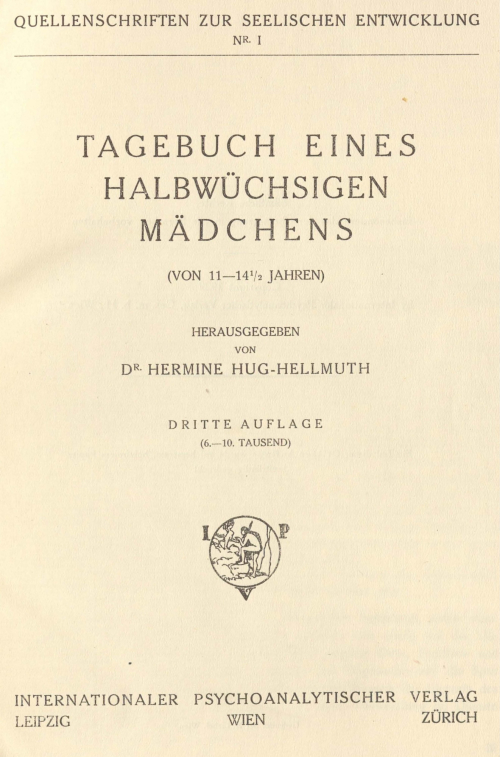 Image 1: The title page of Hug-Hellmuth's Tagebuch
After starting working on the first of our series of ‘Reclaiming Lost Texts’ (on the Writings section on this site), I realised that I needed to discover more about Hermine Hug-Hellmuth and, in particular, her 1913 book, Aus dem Seelenleben des Kindes: eine psychoanalytische studie, which also featured in the Sterns’ 1914 criticisms of child psychoanalysis. I therefore incorporated ‘A Short Note on Hug-Hellmuth’, as Appendix C of ‘Reclaiming Lost Texts, No. 1’, in order to help contextualise and gloss certain aspects of the Sterns’ text. It was this research which then prompted me to translate Josef Krug’s 1926 essay, ‘Critical remarks on the Diary of an Adolescent Girl’, as the second in our series of ‘Reclaiming Lost Texts’. And it was during this research that I discovered three German texts which bore directly on this subject: the book on Hug-Hellmuth, by Graft-Nold (1988), the fine monograph, ‘Stern versus Freud’, also by Graft-Nold (1991), and a fine essay by Anne-Kathrin Reulecke (2013) in which she discusses Hug-Hellmuth’s Tagebuch eines halbwüchsigen Mädchens (Diary of an Adolescent Girl) in detail. As these three texts had not been translated into English they have remained, more or less, in the margins of the English language discourse. With this in mind I approached Anne-Kathrin Reulecke and I am delighted to say that she has given us permission to publish a translation of her essay (which you can read here). At about this same time my co-editor, Roger, noticed that Karnac had recently published a book on Hug-Hellmuth, written by Prophecy Coles (2025) and, on his urging, I agreed to review the book for this site. Thus, in relatively short order, and without any serious planning, we had effectively assembled four texts which, in various ways, touched upon different aspects of Hug-Hellmuth’s life and, more particularly, on ‘her’ Diary of an Adolescent Girl also known as the Tagebuch.
In Appendix C, which is attached to my translation of Krug’s ‘Critical remarks on the Diary of an Adolescent Girl’, I set out my own reconstruction of the history of the Tagebuch. It was through writing that history that I suddenly became aware of the almost cavalier approach to documents and primary sources which had been adopted by those few historians and commentators who had bothered to notice this disquieting episode in the history of psychoanalysis. In these brief comments I would simply like to highlight two of the documents which ‘Anglo-Saxon’ historians of psychoanalysis seem to have, more or less, excised from the history. The first document is the full page ‘notice’ issued by the Internationaler Psychoanalytischer Verlag (the International Psychoanalytic Publishing Company), which was addressed directly to the book trade, and which announced that the Verlag was now withdrawing the Tagebuch from further sale.

Image 2: The IPV's notice withdrawing the Tagebuch as published in the Börsenblatt für den deutschen Buchhandels in 1927
As far as I am aware this ‘notice’, which was published in the March 1927 issue of the Börsenblatt für den deutschen Buchhandels (Financial Newspaper for the German Book Trade) remains the only public statement by the psychoanalytic establishment ever made on the fate of the Tagebuch and, as far as I know, this will be the first time that this important text has been published in English translation (see Appendix C (IV), of the Krug translation). I might also add, in passing, that the Verlag’s March 1927 ‘notice’ offers an early example of how an astute reader (Krug) succeeded in forcing a publisher (the Verlag) to retract one of their texts.[1] The second document is the ‘Statement’ which Hug-Hellmuth wrote, at Freud’s urging, to reveal herself as the hitherto anonymous editor of the Tagebuch, in order to offer a ‘guarantee for the authenticity of the [diary]’ and also as a way of meeting the criticisms which had been levelled against ‘her’ book, particularly by ‘Cyril Burt, the diary’s most strenuous critic’. Although Hug-Hellmuth’s defence was published in the third (1923) German edition of the Tagebuch, I was somewhat amazed to discover that Hug-Hellmuth’s ‘Statement’ seems never to have been republished and, as far as I am aware, this will now be the first time that it will be published in English translation[2] (see Appendix E, of the Krug text].
philip kuhn, 29 January 2026
Notes
[1] On this see, for example, ‘Retraction Watch: Tracking retractions as a window into the scientific process’, https://retractionwatch.com
[2] Hug-Hellmuth’s statement was partially discussed by MacLean & Rappen (1991, pp.28-30); see my Krug essay Section XII, p.28.
Histories of Psychoanalysis
'If Auden’s diagnosis is still accurate, writing the history of psychoanalysis is rather like writing the history of the weather in the twentieth century: its presence is so constant and all-pervasive that escaping its influence is out of the question'.[1]
We have created this website to help facilitate and encourage wider interest in the study and understanding of the rich and varied histories of psychoanalysis and to create a digital library which will capture at least some of the burgeoning array of resources that inform and shape those discourses which gravitate around psychoanalysis. We hope therefore that this site will encompass the following: listings of archives, resources and depositories; publications, assemblages of bibliographies and dis-assemblages of libraries; essays, feuilletons, blogs, reviews, notices and abstracts of books and articles; indeed, any other aspects of this subject which are likely to be of interest to our readers. We also hope to encourage writing brief biographies or vignettes of those early practitioners who have all but disappeared from the story either because they were deliberately written out of the record or because they were simply overlooked and, having been overlooked have become forgotten, and faded like the many ghosts that inhabit those liminal spaces that lie beyond even the pale of the footnote. In short we hope that this site will become something of a Baedeker’s Guide serving to inform, instruct, captivate and entertain a broad spectrum of readers: from the casual browser, through to the serious scholar wishing to widen, broaden and deepen their engagement with this patchwork of disciplines and discourses corralled under the title of psychoanalysis. We are open to lurkers, occasional readers, students, academics, practitioners, clinicians, contributors, authors, dilettantes, even pedants desirous of taking us to task for our errors.
To initiate this first tentative dialogical encounter with our readers, we provisionally suggest that psychoanalysis be here understood in its broadest sense: as a body of knowledge which informs followers, adherents, acolytes or critics, in their responses to some or all of the writings of Sigmund Freud. There are those who see psychoanalysis as a particular – maybe even peculiar - theoretical construct for understanding and exploring the operations of the unconscious mind. There are those who see psychoanalysis as a research activity or a diagnostic tool; a necessary first step on the road to offering analysands, patients or clients a balm for their mental and physical states. There are others who see it as a clinical practise holding out the promise of self-knowledge as well as the hope of well-being. There are others who see it is a framework, somewhat like a pair of spectacles, through which to read the world and its texts. The reading not only of psychoanalytical, psychological, psychopathological, or psychiatric texts but also those non-medical texts which ‘go beyond the clinical sphere’ and which encourage adherents to embrace those ‘kindred studies having a bearing on Psycho-Analysis’.[2] Or to put it differently: to read those texts which have been harvested, appropriated or expropriated, from all those (alien) disciplines which psychoanalysts have attempted to learn from, to colonise or tyrannise, depending on your point of view. Here we are thinking, inter alia, of archaeology, education, mythology, philology,[3] sociology, folklore, criminology, literature,[4] painting and the plastic arts.
 Image: An unused bookplate designed by Irish illustrator and artist David Wilson (1872-1935) for the BPAS
(Image courtesy of BPAS Archives, London)
The history of psychoanalysis, like its clinical practise, has been the subject of controversy from its very beginnings; a discipline and a practice under attack whether that attack be real or imagined. It was from out of this state of active or passive siege that Freud, and his early followers, occasionally sublimated their fears by writing, re-writing and revising their history. At first Freud set the tone with his surreptitious revisions; reframing and adjusting his accounts of the early years of his psychotherapeutic career.[5] But then Freud’s rhetoric became even more strident with his 1914 essay ‘On the history of the psychoanalytic movement’[6] which was not so much a history of the beginnings of psychoanalysis as an excuse for a sustained polemic against Adler and Jung.[7] Ernest Jones, who is still considered the arch-historian of psychoanalysis, also engaged from early on in a life-long attempt to fashion and re-fashion its history. Jones’s process can be traced from his 1909 ‘Review of the Freudian Literature&rsquo[8]] through to his ‘authorised’ biography of Freud[9] and then on to Free Associations,[10] the autobiography which he wrote in his final attempt to stake out his sometimes spurious claims to have been a witness at the origins.[11] Ultimately Jones’s writings, masquerading as biography or autobiography, are polemical texts and although shown to be often deeply corrupted they continue to serve as a kind of benchmark for reading The History of Psychoanalysis. The anonymously authored ‘History of the British Psycho-Analytical Society,’[12] which was probably also written by Jones, is yet another polemic in a long line of ‘officially’ sanctioned histories written to promote an unashamedly partisan point of view and, at the same time, spin that comforting fairy-tale of a Freudian ‘family romance.’ Erich Fromm had a point when he noted that Freudian histories were not unlike Stalinist histories, written to support the prevailing party line where judgement, without expulsion, was a rarity and where critics with dissenting views were written out of the narrative.[13] It is perhaps not surprising that Alain de Mijolla thought that psychoanalysts were really not that interested in their history.[14]
From around the 1950s a small number of scholars started questioning the received party-line; slowly chipping away at its monolithic structure. From their early work there emerged a number of ground-breaking studies such as Henri F. Ellenberger’s The Discovery of the Unconscious (1970), Frank J. Sulloway’s Freud, Biologist of the Mind, (1979) and Albrecht Hirschmüller’s, The Life and Work of Josef Breuer (1978) to name just three. But it was probably not until the early 1990s that revisionist historians began to assume something of a critical mass which then led, in turn, to an atmosphere of a perceived state of siege in which a number of Freudian scholars, assumed their positions. Battle lines were drawn, barricades were manned (sic) and otherwise ‘neutral’ scholars were exhorted, perhaps even despite themselves, to defend or oppose the Freudian Weltanschauung or world view, with each side fiercely and aggressively defending, contesting, revising, elaborating, or augmenting their received visions and versions of Freud or proselytizing the multiple ways in which the history of psychoanalysis ought be read. The debates were often reduced to ‘Freudians’ versus ‘anti-Freudians’ with the former categorizing the latter as ‘Freud-bashers’. Although the ‘Freud Wars’ of the 1990s and early 2000s were often brutal, it is now possible, from a distance, of time to begin to frame those battles, and arguments,[15] in the guise of Jonathan Swift’s Tale of a Tub.[16] And with much of the smoke, sound and fury having cleared, it is also now possible to identify another parallel strand in the historiography of psychoanalysis by identifying the plethora of books which have sought to rehabilitate a number of those early practitioners who were excluded (sometimes cynically) from the pantheon of psychoanalytic heroes: Eric Fromm,[17] Otto Gross,[18] Otto Rank,[19] Wilhelm Reich,[20] and Sándor Ferenczi,[21] to name just a few.
By inviting the active participation of its readers, the editors of Histories of Psychoanalysis aim to host, stimulate or curate a wide range of additions and contributions: historical, polemical, biographical, autobiographical, pictorial, indeed anything which might seem relevant and which might also be usefully included in this already unruly and chaotic field.
philip kuhn and Roger Willoughby, 14 April 2025
Notes:
[1] J. Forrester, Dispatches from the Freud Wars: Psychoanalysis and its Passions. Cambridge: Harvard University Press, 1997, p.184.
[2] See e.g., The International Journal of Psychoanalysis 1920, Vol.1, p.5
[3] For a powerful Marxist critique of The Psychopathology of Everyday Life see S. Timpanaro, The Freudian Slip: Psychoanalysis and Textual Criticism, translated by Kate Soper, London: Verso, 1976.
[4] One of the earliest colonizations of literature can be found in Ernest Jones’s Freud inspired, ‘The Oedipus-Complex as an Explanation of Hamlet’s Mystery: A study in Motive’ which was first published in The American Journal of Psychology, 1910, Vol.21, pp.72-113. Despite its popularity, not everybody has been convinced by Jones’s Oedipal interpretation; see for example Rayner Heppenstall’s ‘Preface’ and also his ‘Introduction’ to ‘The Fool’s Saga’ which can be found in R. Heppenstall & M. Innes, Three Tales of Hamlet, London: Victor Gollancz, 1950.
[5] See e.g., P. Kuhn, ‘Sigmund Freud’s Discovery of the Etiological Significance of Childhood Sexual Traumas’, Journal of Child Sexual Abuse, 1997, Vol.6, pp.107-108.
[6] S. Freud ‘On the history of the psychoanalytic movement’ (1914), Standard Edition, Vol.14, pp.1–66.
[7] See e.g., M. Borch-Jacobsen & S. Shamdasani, The Freud Files: An Inquiry into the History of Psychoanalysis, Cambridge: Cambridge University Press, 2012.
[8] E. Jones, ‘Review of the recent English and American literature on clinical psychology and psychopathology’, Archives of Neurology from the Pathological Laboratory of the L.C.C. Asylums, Claybury, ed. F. W. Mott. London: P. S. King & Son, 1911, [1909]), Vol. 5, pp.120–47.
[9] E. Jones, Sigmund Freud: Life and Work, 3 volumes, London: Hogarth Press, 1953-1957.
[10] E. Jones, Free Associations; Memories of a Psycho-Analyst, London: The Hogarth Press, 1959.
[11] We use origins, as opposed to beginnings, so as to capture that sense of the divine, mythical and privileged which often inform the assumptions behind many of the ‘orthodox’ histories.
[12] Anon, ‘History of the British Psycho-Analytical Society’, International Journal of Psychoanalysis, 1920, Vol. 1, No. 1, pp. 115-118.
[13] See E. Fromm (1958) ‘Vom parteigeist der psychoanalytischen bewegung und ihren opfern [On the party-spiritedness of the psychoanalytic movement and its victims]’, E. Fromm, Schriften ueber Sigmund Freud, Stuttgart: Deutsche Verlagsanstalt, 1989, pp.195-204.
[14] Alain de Mijolla & Annick Ohayon, ‘De l’histoire personnelle à l’histoire de la psychanalyse: une trajectoire‘, Nouvelle Revue de Psychosociologie, 2015, Vol. 2, 2, p. 254.
[15] See e.g., R. Wilcocks Maelzel’s Chess Player: Sigmund Freud and the Rhetoric of Deceit. Lanham: Roman & Littlefield, 1994; F. Crews (ed) The Memory Wars: Freud’s Legacy in Dispute, New York: New York Review of Books, 1995; R. Webster Why Freud was Wrong: Sin, Science and Psychoanalysis, London: Harper Collins, 1995; F. Crews (ed) Unauthorized Freud: Doubters Confront a Legend, New York: Penguin, 1998; F. Cioffi Freud and the Question of Pseudoscience, Chicago: Open Court, 1998. On the other side see J. Forrester, Dispatches from the Freud Wars: Psychoanalysis and its Passions, Cambridge: Harvard University Press, 1997.
[16] J. Swift A Tale of a Tub: Written for the Universal Improvement of Mankind. To which is Added, an Account of a Battle between the Ancient and Modern Books in St. James’s Library &c, New York: Willian Durell & Co., 1812.
[17] D. Burston The Legacy of Erich Fromm. Cambridge: Harvard University Press, 1991; R. Funk Erich Fromm: His Life and Ideas, an Illustrated Biography, translated by Ian Portman & Manuela Kunkel, New York: Continuum, 2000; L. J. Friedman The lives of Erich Fromm: Love’s Prophet, New York: Columbia University, 2013.
[18] G. Heuer Freud's ‘Outstanding’ Colleague/Jung's ‘Twin Brother.’ The suppressed psychoanalytic and political significance of Otto Gross, London: Routledge, 2016.
[19] E. J. Lieberman Acts of Will: The Life and Work of Otto Rank, New York: Free Press, 1998.
[20] M. Sharaf Fury On Earth: A Biography Of Wilhelm Reich., New York: Da Capo Press, 1994.
[21] The literature on Ferenczi has now become far too extensive to list in a mere footnote although, perhaps not surprisingly, early critical studies seem to be giving way to work verging upon hagiography. See e.g., A. Fergusson & M. Gutiérrez-Peláez Sándor Ferenczi: A Contemporary Introduction, Oxford: Routledge, 2022.